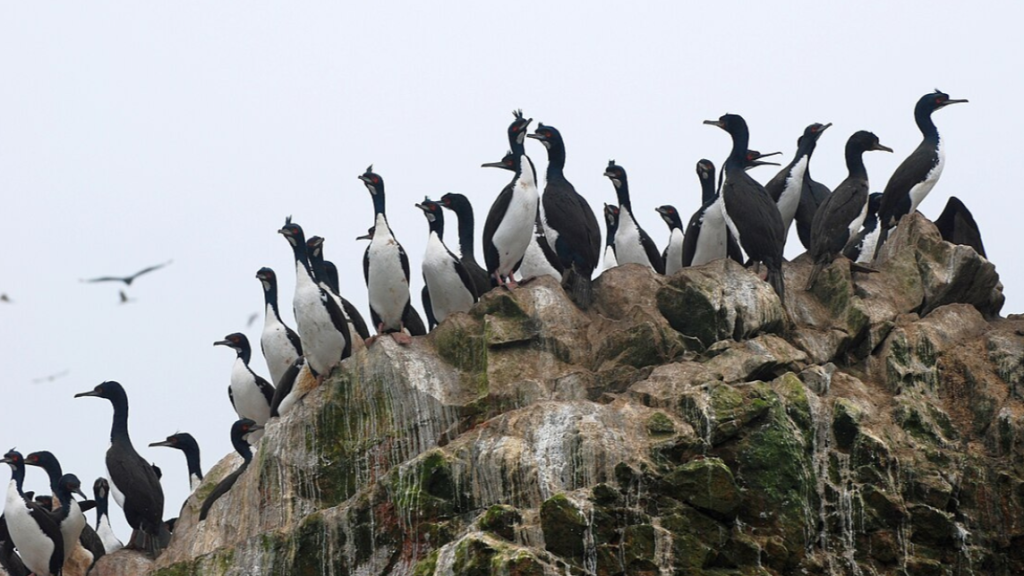
Scientists along Peru’s Pacific coast are raising serious concerns over a drastic decline in guano coastal bird populations. Once numbering around 4 million in 2022, these seabirds have now fallen to just about 500,000. This represents a decline of more than 75% in only three years. The collapse of these populations not only threatens Peru’s marine ecosystem but also endangers the guano fertilizer industry and other species, including sea lions and Humboldt penguins, that depend on the same fragile environment.
The decline has unfolded through a sequence of interconnected pressures. It began in 2022 with an outbreak of avian flu, which wiped out tens of thousands of birds and also spread to sea lions and penguins. The following year, El Niño disrupted marine food chains by pushing anchoveta, a vital food source, into deeper waters, leaving many birds without enough to eat. In 2024, overfishing compounded the crisis, as authorities permitted the largest anchoveta catch quota in seven years. While intended to support the fishing industry, scientists cautioned that the stock was not sufficient to feed both human demand and the dependent marine species.
The ecological and economic consequences are already visible. Guano, a nutrient-rich natural fertilizer harvested under strict government supervision every five years, is at risk. The most recent collection in 2024 revealed lower yields, and with bird populations continuing to shrink, the sustainability of future harvests is uncertain. For local farmers and exporters, this represents not only a supply issue but also the erosion of a centuries-old practice tied closely to Peru’s agricultural history.
At Punta San Juan reserve, only 200,000 guano birds remain, alongside 2,500 Humboldt penguins and 11,000 sea lions. These numbers show the wider ecological stress rippling through the Humboldt Current system, one of the most productive marine ecosystems in the world. If protections are not strengthened, biologists warn that Humboldt penguins could disappear entirely within the next century.
The Peruvian government has announced plans to repopulate guano birds in collaboration with conservation groups, yet challenges remain. The tension between economic priorities, such as fishing quotas, and the survival of marine ecosystems continues to complicate solutions. Meanwhile, climate change adds further uncertainty, as warming waters and shifting ocean patterns weaken the resilience of already vulnerable species.
This unfolding crisis highlights how disease, climate variability, and human activity can converge to rapidly destabilize ecosystems. It also serves as a reminder that sustainable management of natural resources requires a holistic approach—balancing economic needs with long-term environmental stewardship.