

Floods in Malaysia are a recurring and growing issue, especially during the monsoon season, creating substantial waste challenges. In 2023, the Department of Irrigation and Drainage (DID) in Malaysia defined a flood as a body of water rising, swelling, and overflowing land not usually thus covered. Overflowing the bank of a stream, lake, or drainage system onto adjacent land as a result of the storm, ice melt, tidal action, and channel obstruction is also categorized as a flood.
Did you know that floods generate tons of waste, including debris, damaged furniture, and hazardous materials? This not only complicates recovery but also poses health risks.
According to the Department of Statistics Malaysia (DOSM), the total losses due to floods in Malaysia in 2023 amounted to RM800 million which equivalent to 0.04 per cent of the nominal Gross Domestic Product comparing RM1.0 billion in 2022. Living quarters losses amounted to RM168.3 million (2022: RM157.4 million), vehicles RM22.3 million (2022: RM18.8 million), manufacturing RM10.3 million (2022: RM8.7 million), business premises RM53.2 million (2022: RM50.3 million), agriculture RM120.6 million (2022: RM154.5 million), and public assets & infrastructure RM380.7 million (2022: RM636.8 million).

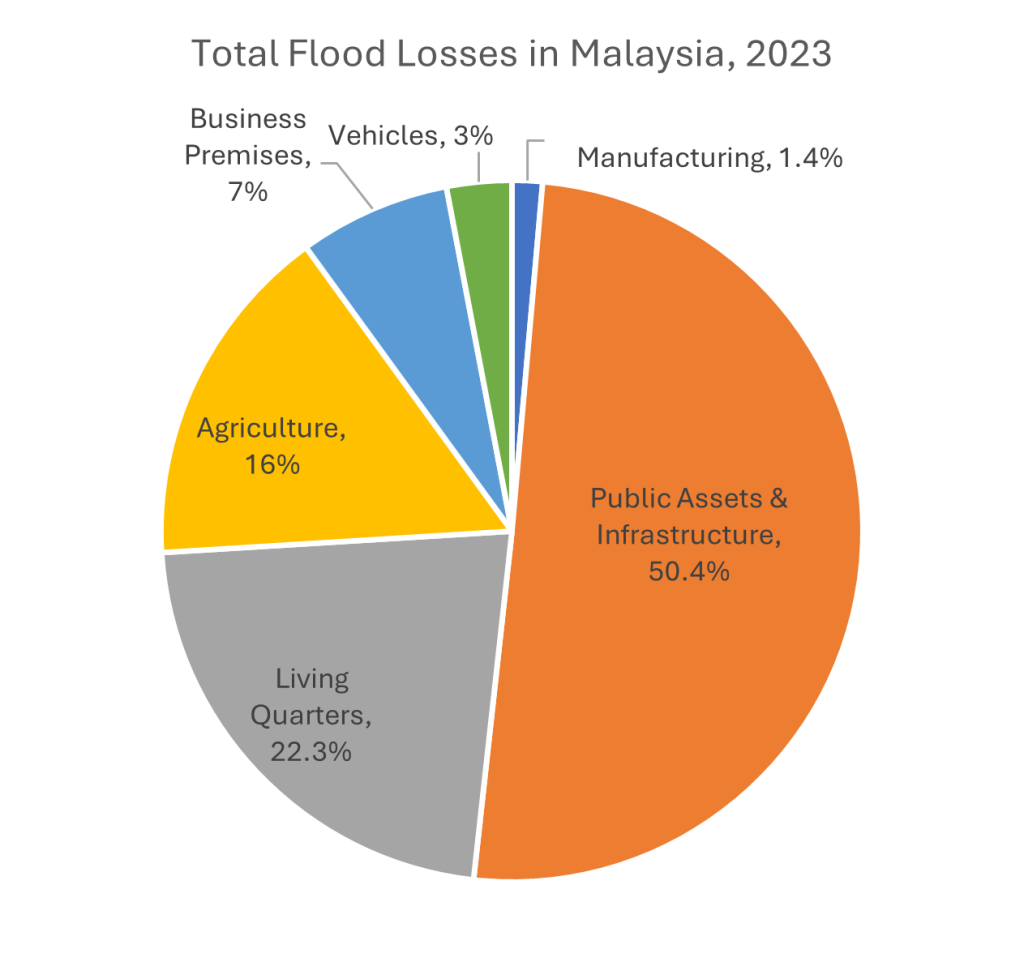
Source: Special Report on the Impact of Floods in Malaysia 2023, DOSM
As someone who has volunteered in post-flood cleanup efforts in Selangor over the past two years, I’ve seen the devastating impact and the remarkable resilience of affected communities. It was a humbling experience to work alongside community members, helping clear debris, segregate waste, and ensure proper disposal to mitigate environmental and health risks.
Key takeaways from my experience:
• Segregation Matters: Effective waste segregation is crucial for minimizing environmental and health hazards. Sorting waste into organic, recyclable, and hazardous categories ensures that each type is handled appropriately, reducing the risk of contamination and improving recycling efficiency. This process also mitigates long-term impacts on local ecosystems and supports sustainable waste management practices.
• Timely Action Saves Lives: Acting quickly in post-flood cleanup operations is vital to prevent the spread of waterborne diseases and other health risks. Swift removal of debris not only clears pathways for emergency responders and aid distribution but also reduces the accumulation of stagnant water, which can become breeding grounds for mosquitoes and other vectors of disease.
• Community Collaboration: The combined efforts of volunteers, NGOs, and local authorities are instrumental in achieving sustainable and impactful recovery. By pooling resources, expertise, and manpower, these collaborations address immediate needs while laying the foundation for long-term resilience. Engaging community members in cleanup activities also fosters a sense of ownership and solidarity, empowering them to rebuild their lives more effectively.
The Solid Waste Management and Public Cleansing Corporation (SWCorp) has also been actively involved in flood waste management. Between November 28 and December 11, 2024, they collected over 12,852 tonnes of flood-related waste across seven states. In Kedah alone, 730 tonnes of flood waste were cleared, using a variety of equipment like mini armrolls and backhoe loaders to ensure efficient removal. 171 waste bins were deployed at temporary relief centers to aid the cleanup efforts. The Deputy Minister emphasized the importance of community responsibility in maintaining cleanliness after floods (The Sun, 2024).
The urgent need for comprehensive post-flood waste management: Improper handling of post-flood waste can lead to disease outbreaks, with vectors like insects and rodents spreading illnesses such as cholera and dengue. Effective waste management is crucial to prevent such threats. The vast amount of waste generated can block roads, drainage systems, and even conceal trapped individuals, hampering recovery efforts.
As floods become more frequent due to climate change, we must strengthen disaster preparedness and improve waste management systems. Beyond immediate relief, we need to invest in long-term solutions—better infrastructure, public awareness, and technology.
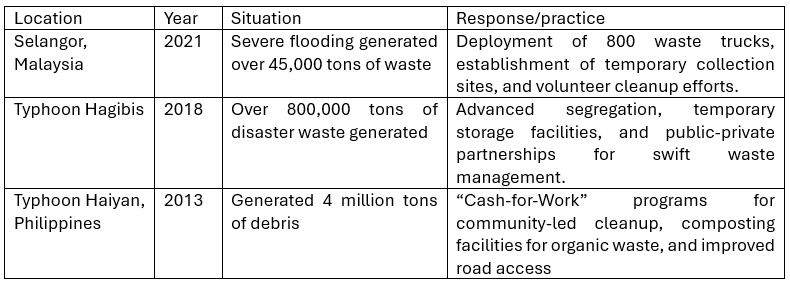
The case study of flooding event and the response
What are your thoughts on improving post-flood waste management in Malaysia? Have you been involved in similar initiatives? Let’s discuss in the comments!
This article was prepared by:
Azirah Arinah, Research Analyst
Sources:
Ismail, S., S., N., et al. 2018. Disaster Debris Management during the 2014-2015 Malaysia Flood Incident. Mal J Med Health Sci 14(SP2): 112-119.
Rosmadi, H. S., Ahmed, M. F., Mokhtar, M. B., & Lim, C. K. (2022). Reviewing Challenges of Flood Risk Management in Malaysia. Water, 15(13), 2390. https://doi.org/10.3390/w15132390
Yusof, N., S. et al. 2016. Disaster Waste Management in Malaysia: Significant Issues, Policies & Strategies. MATEC Web of Conferences 66 IBCC 2016, 00051.
The Department of Statistics Malaysia (DOSM). (2024). Special Report on The Impact of Floods in Malaysia 2023.
https://pentasflora.com/impact-of-urban-floods-to-waste-management-disaster-waste-management/
https://thesun.my/malaysia-news/swcorp-collects-over-12800-tonnes-of-flood-waste-across-seven-states-LE13422977