
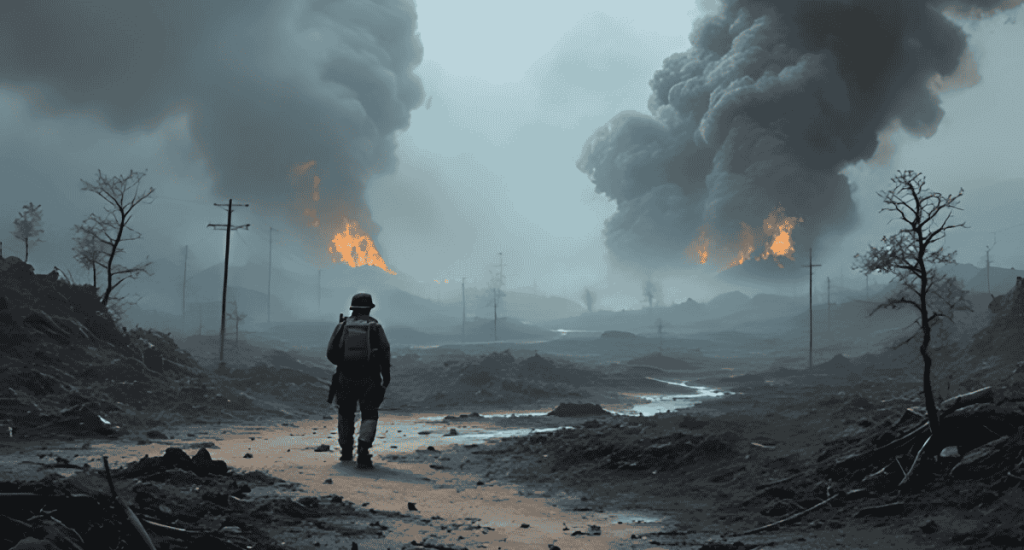
When we think about wars, destroyed cities, displaced families, and shattered lives will be the first to come to our mind. But we tend to overlook, the silent victim of conflict: the environment. As wars rage on across the globe, the damage to our planet is growing in ways that will affect generations to come.
Environmental Destruction in the Line of Fire
Wars do more than harm people—they devastate the environment. Explosions, bombings, and chemical spills contaminate the air, soil, and water, creating long-term damage. Forests are often cleared, rivers poisoned, and wetlands drained for tactical purposes. These losses are often irreversible, further threatening biodiversity and our ability to adapt to climate change.
Take the Vietnam War, where millions of acres of forests were destroyed by chemical defoliants like Agent Orange, causing widespread ecological collapse. Today, much of this land remains barren, unable to sustain life.
In Gaza, continued bombardment has destroyed infrastructure and contaminated vital water supplies, threatening local communities. By August 2024, the 365-square-kilometer Gaza Strip was covered with almost 42 million tonnes of debris, which includes unexploded ordnance, human remains, and dangerous materials like asbestos, according to UNOSAT.
The Ukraine War adds another tragic example. Explosions, burned-out industrial zones, and destroyed farmlands have poisoned the soil and water. Beyond immediate destruction, the global flour shortage caused by the conflict—as Ukraine and Russia collectively supply over 25% of the world’s wheat—highlights its broader environmental and economic consequences.
The Climate Costs of War
Military operations are a significant source of greenhouse gas emissions and energy depletion. The entire lifecycle of weapons, vehicles, and military infrastructure— from production to transportation to use—contributes massively to environmental degradation. For instance:
• The burning of oil fields during the Gulf War released massive amounts of carbon dioxide and pollutants into the atmosphere, accelerating global warming.
• In the Syrian Civil War, bombardments targeted industrial zones, releasing toxic chemicals that worsened air quality and had severe health impacts on civilians.
• During the Ukraine War, explosions and prolonged battles in industrial hubs have released significant toxic substances into the air, further degrading regional air quality.
Wars not only worsen existing environmental crises but also hinder efforts to adapt to and mitigate the effects of climate change, making recovery even more challenging for affected regions.
The effects of war extend far beyond the countries directly involved in the conflict. Armed conflict often leads to refugee crises, putting immense strain on the resources of neighboring countries. This added pressure disrupts everything from water supplies to food systems and can cause a domino effect on global supply chains—especially in agriculture and energy. As neighboring countries struggle to meet basic needs, they often turn to less sustainable methods, further contributing to environmental degradation and increased emissions.
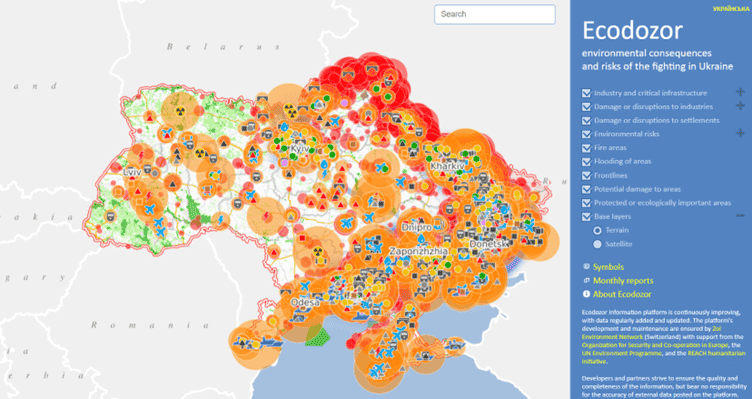
(The Ecodozor Platform for mapping the environmental consequences and risks of the fighting in Ukraine)
Currently, no international standards exist for measuring environmental impacts during conflict. However, countries like Ukraine, the EU, the US, and the UN have developed strategies to assess war-related environmental damage, using tools like satellite imagery, open-source data, and field visits. Platforms like Ukraine’s EcoZagroza and Ecodozor, developed with international organizations, help monitor impacts on ecosystems, infrastructure, and pollution, supporting remediation efforts and reparations. Civil society groups like SaveEcoBot and Ecoaction are also contributing to these assessments.
The Ecological Fallout of Warfare
- Deforestation and Habitat Destruction
Military operations often destroy entire ecosystems. During the Vietnam War, the use of Agent Orange destroyed five million acres of forest, wiping out wildlife habitats and contributing to the extinction of species. - Soil and Water Contamination
War often poisons vital resources. During the Gulf War, oil spills turned the Persian Gulf into a toxic wasteland, devastating marine ecosystems. In Iraq, years of conflict have left rivers like the Tigris and Euphrates polluted with chemicals and heavy metals, making water sources undrinkable and agricultural land barren. - Air Pollution and Climate Impact
The smoke of war doesn’t just darken skies—it poisons them. During the 1991 Gulf War, burning oil wells released millions of tons of carbon dioxide, darkening the skies and contributing to regional and global air pollution. In Syria, ongoing bombings have targeted industrial zones, releasing toxic chemicals that degrade air quality and harm public health. - Waste and Resource Depletion
War generates massive amounts of waste, leaving behind debris, landmines, and abandoned military equipment. In Afghanistan, decades of conflict have contaminated vast areas with landmines, making them unusable for agriculture and exacerbating food insecurity. Additionally, conflicts often lead to the exploitation of natural resources like diamonds, timber, and minerals, further depleting ecosystems.
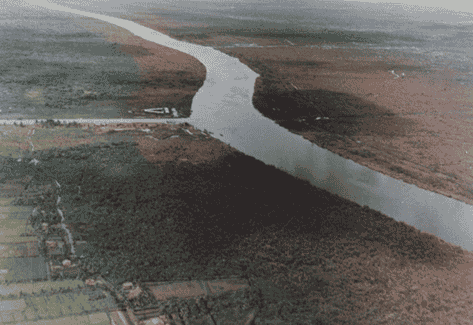
An aerial photograph showing the effects of Agent Orange. The land on the left hasn’t been sprayed while the land on the right has. (Credit: Admiral Elmo R. Zumwalt, Jr. Collection: Agent Orange Subject Files/The Vietnam Center and Archive/Texas Tech Uni)
Why Environmental Peace Is Human Peace
Humans, by nature, are creatures of survival—bound by the instinct to protect their own future and pass their legacy forward. We group together, often divided by differing beliefs and ideologies, which throughout history have ignited countless wars. Yet, war’s toll extends far beyond human suffering—it deeply scars the very Earth that sustains us.
Bombs destroy life, tanks crush fragile ecosystems, and industrialized warfare contaminates soil, water, and air. Whether through oil spills, deforestation, or toxic residues, war irreversibly harms the natural world, undermining the delicate balance on which all life depends.
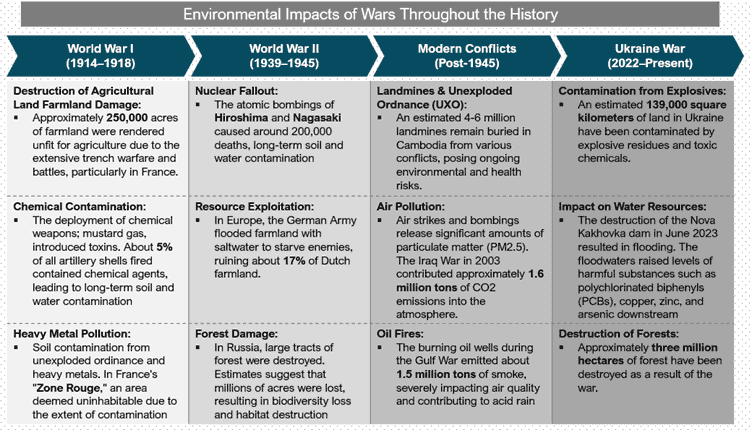
(Environmental impacts of wars throughout history)
Our Responsibility to Protect the Earth
The scars of war do not respect borders. As stewards of the Earth, humans have both the knowledge and the responsibility to protect the environment. War destroys not only our way of life but also the resources that sustain us. Our collective survival depends on ensuring a healthy, stable environment for future generations.
The path to peace begins with awareness and action. We can all make a difference by:
• Promote Awareness: Educate others about the environmental destruction caused by war and the importance of peace for the planet’s health.
• Support Sustainable Recovery: Advocate for environmental restoration in post-conflict areas through reforestation, cleanup efforts, and biodiversity conservation.
• Demand Accountability: Call for the enforcement of international laws that protect the environment during armed conflict, such as the Geneva Conventions, that protect the environment during armed conflict. These laws prohibit the use of warfare tactics that cause long-lasting, severe environmental damage.
• Foster Dialogue: Address resource-driven conflicts by promoting sustainable management of natural resources. Tackling these root causes can prevent disputes from escalating.
By advocating for peace, we are championing a future where humanity and nature can thrive together. The power to protect the environment and ensure lasting peace lies in our collective hands. Together, we can create a world where environmental stewardship and compassion shape a better future for all.
This article was prepared by:
Iman Hidayah, Research Analyst
Sources:
Stone, E. (2024, April 17). Calculating The Environmental Cost of War. UIC. https://today.uic.edu/environmental-impact-ukraine-war/
Weir, D. (2020, June 4). How does war damage the environment? CEOBS. https://ceobs.org/how-does-war-damage-the-environment/
Pereira, P., Bašić, F., Bogunovic, I., & Barcelo, D. (2022). Russian-Ukrainian war impacts the total environment. Science of The Total Environment, 837, 155865.
Damme, O. V., & Le Cadre, A.-S. F. (2024, August 1). Gaza: Debris generated by the current conflict is 14 times more than the combined sum of all debris generated by other conflicts since 2008. The United Nations Satellite Centre (UNOSAT). https://unitar.org/about/news-stories/news/gaza-debris-generated-current-conflict-14-times-more-combined-sum-all-debris-generated-other