
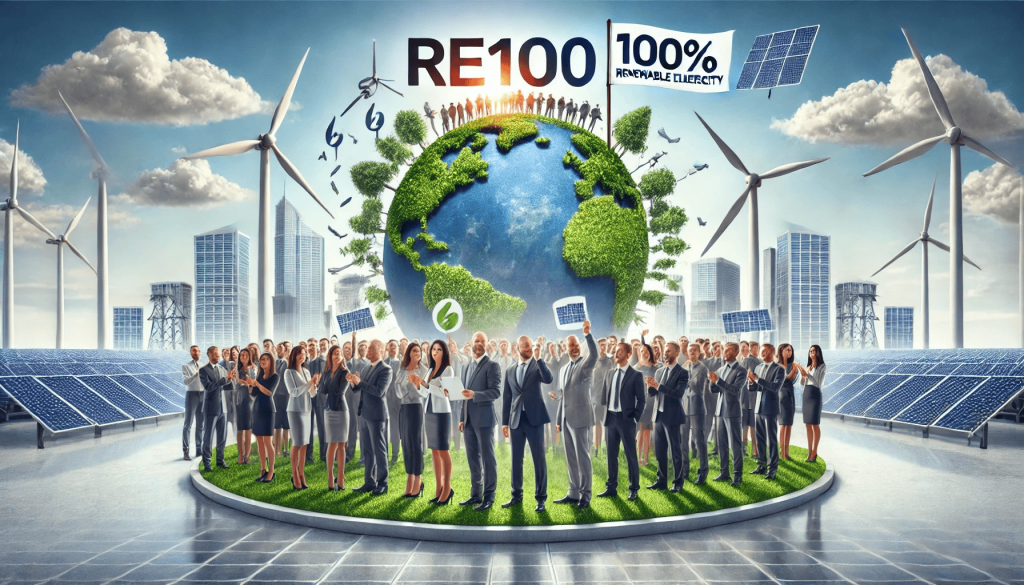
This year, 2024 marks a decade for the global corporate renewable energy initiative, named as RE100 which bring over 400 world’s most influential companies in driving the shift towards 100% renewable electricity by 2050. Collectively, these businesses consume more than 500 terawatt-hours (TWh) of electricity annually, surpassing the consumption of entire nations like France. This revolutionary initiative not only demonstrates the power of corporate action in combating climate change but also highlights the crucial role of businesses in pushing the world towards a future powered by clean, renewable energy.
Corporate Approaches
Google has been a frontrunner in corporate renewable energy commitment, achieving its goal of sourcing 100% renewable energy for its global operations for four consecutive years, 2017-2020. This encompasses all of its data centers and corporate offices, making Google the largest corporate buyer of renewable energy worldwide by 2020.
As for that achievement, Google have signed for power buying from more than 50 renewable energy projects, with a combined capacity of 5.5 gigawatts – about the same as a million solar rooftops. With investments in numerous wind and solar projects, Google not only reduces its carbon footprint but also sets a precedent in the tech industry, encouraging other companies to follow suit. This commitment underscores the importance of corporate responsibility in driving large-scale adoption of renewable energy solutions.
Apple has made renewable energy and energy efficiency central to its corporate strategy. Since achieving 100% renewable energy for its global corporate operations in 2013, the company has continued to prioritize reducing energy consumption across its product lifecycle. Through the implementation of energy-efficient technologies and by encouraging its suppliers to transition to renewable energy, Apple demonstrates a comprehensive approach to sustainability. This dual strategy—improving energy efficiency while sourcing clean power—highlights how businesses can significantly reduce their environmental impact while promoting sustainability across supply chains.
Apple remains committed to maintaining 100% renewable energy for its operations, focusing on developing new projects and transitioning its entire supply chain to clean power. More than 70 suppliers have pledged to use 100% renewable energy for Apple production, amounting to nearly 8 gigawatts of clean energy commitments. These efforts are expected to avoid over 14.3 million metric tons of CO2e annually, equivalent to taking more than 3 million cars off the road each year.
New and completed renewable energy projects in Arizona, Oregon, and Illinois have expanded Apple’s corporate renewable capacity to over 1 gigawatt—enough to power more than 150,000 homes annually. Notably, over 80% of the renewable energy sourced for Apple facilities comes from Apple-initiated projects, delivering benefits to local communities and businesses alike.
Globally, Apple is advancing sustainability with initiatives such as launching one of the largest solar arrays in Scandinavia and developing two renewable energy projects to serve underserved communities in the Philippines and Thailand. These projects reflect Apple’s commitment to fostering clean energy access and advancing environmental stewardship worldwide.
Walmart, as a global retail leader, Walmart has committed to powering its operations entirely with renewable energy by 2035. To achieve this goal, the company employs Renewable Energy Certificates (RECs) and invests heavily in wind and solar initiatives. By 2020, Walmart had already sourced 36% of its energy from renewable sources, demonstrating its dedication to sustainability. This approach not only helps Walmart meet its energy goals but also inspires its supply chain to adopt similar practices, amplifying its environmental impact.
In January 2024, Walmart announced plans to accelerate its energy transformation strategy, focusing on projects that drive meaningful community benefits. The company committed to enabling nearly 1 gigawatt (GW) of new clean energy projects across the United States. These initiatives aim to expand access to renewable energy, create local jobs, generate tax revenue for communities, and provide direct savings for customers and community members.
Walmart’s efforts include two community solar and distributed generation portfolios developed by Pivot Energy and Reactivate. These portfolios consist of 70 megawatts (MWac) from 26 installations across six states, expected to generate ~160,000 MWh of clean energy annually. This energy output will support community solar subscriptions for ~13,000 U.S. households, delivering ~$8 million in annual energy savings. Of this, ~$6 million will benefit low-to-moderate-income (LMI) households, helping make clean energy more accessible to underserved communities.
By 2030, Walmart aims to enable 10 gigawatts of new clean energy projects—enough to power over 2 million households. This ambitious effort is designed to create a cleaner energy system, reduce emissions, and enhance energy resilience while delivering savings to customers and communities. Through these investments, Walmart reinforces its leadership in sustainability, demonstrating how businesses can grow responsibly while delivering measurable benefits to their customers, communities, and the planet. By transforming its energy strategy, Walmart is paving the way for a greener, more sustainable future.
Conclusion
In summary, the collective efforts of global companies like Google, Apple, and Walmart highlight the critical role of corporate leadership in driving the transition to renewable energy. Through ambitious goals, innovative strategies, and substantial investments in clean energy projects, these companies are not only reducing their own carbon footprints but also creating ripple effects across industries and communities. Their commitment to sustainability demonstrates that addressing climate change is both a responsibility and an opportunity to foster economic growth, enhance energy resilience, and empower local communities. As more businesses follow their lead, the vision of a renewable energy-powered future becomes increasingly attainable, reinforcing the importance of corporate action in creating a sustainable and equitable planet.
Sources:
10 years of RE100 | RE100. (n.d.). RE100. https://www.there100.org/10-year-anniversary
Hölzle, U. (2021, April 21). Google achieves four consecutive years of 100% renewable energy. Google Cloud Blog. https://cloud.google.com/blog/topics/sustainability/google-achieves-four-consecutive-years-of-100-percent-renewable-energy
Apple. (2024, October 29). Apple commits to be 100 percent carbon neutral for its supply chain and products by 2030. Apple Newsroom. https://www.apple.com/newsroom/2020/07/apple-commits-to-be-100-percent-carbon-neutral-for-its-supply-chain-and-products-by-2030/
Kapadia, V. (2024, March 26). Walmart accelerates clean energy purchases and investments with nearly 1 GW of new projects across the U.S. Walmart. https://corporate.walmart.com/news/2024/03/26/walmart-accelerates-clean-energy-purchases-and-investments-with-nearly-1-gm-of-new-projects-across-the-us