
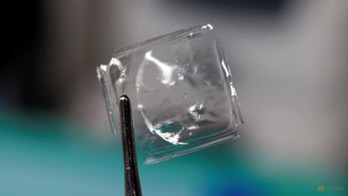
In what may become a defining breakthrough in the fight against plastic pollution, scientists from RIKEN Center for Emergent Matter Science and the University of Tokyo have developed a new type of plastic that dissolves completely in seawater within hours, leaving no microplastics, no toxic residue and no trace behind.
Unlike conventional plastics, which can persist in the environment for centuries or even current biodegradable alternatives, this new material degrades rapidly in saltwater. In a demonstration at a lab in Wako, near Tokyo, a small piece of the plastic disappeared in about an hour after being stirred in a container of saltwater.
Its design leverages ionic monomers, specifically sodium hexametaphosphate (a common food additive) and guanidinium-based monomers, which are bound by reversible salt bridges. When exposed to seawater, these bridges are disrupted, causing the material to disintegrate into original, digestible components, which an elegant solution to a persistent global problem.
According to the UN Environment Programme, plastic waste in oceans could triple by 2040, reaching up to 37 million metric tons annually. Microplastics, one of the most insidious forms of pollution, are already showing up in the food chain, drinking water and even human blood. This new material avoids such fragmentation entirely, as it dissolves into harmless molecules that can be metabolized by marine bacteria. Better yet, more than 90% of its base components can be recovered and reused, a potential pathway toward a circular plastic economy.
In soil, the plastic degrades within 8–10 days (for a 5 cm piece), releasing nutrients like phosphorus and nitrogen, which could even support plant growth. The material is also non-toxic, non-flammable and doesn’t emit carbon dioxide during breakdown.
One of the main barriers for existing biodegradable plastics has been their lack of durability. That’s not the case here. Researchers claim this seawater-dissolving plastic is as strong as petroleum-based plastic and its properties can be tuned for applications requiring flexibility, transparency or heat resistance. The team is now exploring eco-friendly coating methods to make the material stable in daily use but still degradable after disposal.
As the world continues to negotiate a global plastics treaty, this discovery offers real hope and proof that we can design waste out of the system, not just manage it.
Let’s hope the world is watching and ready to invest in materials that leave no trace behind.