
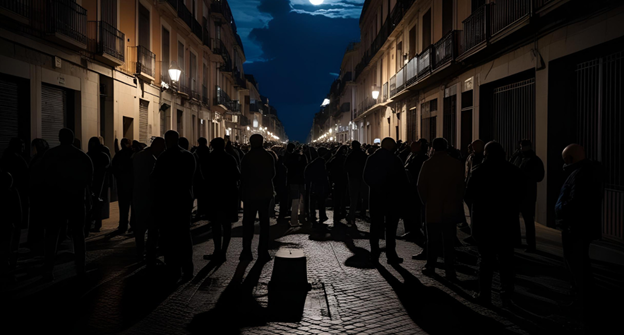
On April 28, 2025, a sudden and severe blackout swept across Spain and Portugal in one of Europe’s most significant energy infrastructure failures in recent memory. Within five seconds, Spain lost a staggering 15 GW of electricity—representing 60% of its national demand. The event not only halted transport, communications, and business but exposed a deeper vulnerability at the core of modern electricity grids transitioning towards cleaner energy.
🔌 What Went Wrong? According to Spain’s grid operator Red Eléctrica and Portugal’s REN, the outage was triggered by a “strong oscillation” in the power flow. While investigations are ongoing, early findings point to a convergence of technical and environmental factors:
- Grid Instability & Low Inertia: Spain’s power system was operating with very low rotational inertia—traditionally provided by large spinning generators such as coal and gas plants. The dominance of inverter-based renewables like solar (which accounted for nearly 59% of generation at the time) reduced the grid’s ability to absorb shocks. When solar PV generation plunged by over 50% within minutes (from 18 GW to 8 GW), the system collapsed under the weight of its own fragility.
- Atmospheric Conditions: Portugal’s grid operator cited extreme temperature variations and atmospheric vibration in high-voltage lines—potentially triggering mechanical instabilities in the transmission infrastructure.
- Interconnector Breakdown: As Spain’s grid disconnected from France’s due to the imbalance, the Iberian Peninsula became electrically isolated. This severance from Europe’s larger grid prevented external balancing resources from containing the failure.
Critically, renewables were not the cause. Both solar and wind disengaged as part of automated safety responses—just like conventional gas and nuclear plants. Yet the systemic lack of backup flexibility revealed a key lesson: without modernized infrastructure and proper grid-forming technologies, even the cleanest energy sources can struggle to deliver stable power.
🌍 A Fully Interconnected Risk
Spain and Portugal operate on a synchronized grid, connected to France, Morocco, and Andorra. When Spain’s grid tripped, Portugal’s collapsed as well due to the shared infrastructure. The blackout also briefly disrupted France’s export capacity, showing how grid events in one region can cascade across borders.
🧯 The Response and Restoration
It took between 6 to 10 hours to restore power across both nations. Hydropower stations and imports from Morocco and France played a key role in restarting the grid—underscoring the importance of dispatchable and stored energy. However, existing battery storage (about 1.5 GW in Spain) was insufficient and largely disengaged during the frequency collapse, as protocols require.
Hospitals ran on generators. Trains in Madrid and Lisbon halted mid-tunnel. Airports closed partially. ATMs crashed, and mobile networks failed in some regions. Major industrial plants like Ford were forced to shut down, while retail stores, offices, and even live sporting events like the Madrid Open came to a standstill.
📉 The Economic Fallout
Though annual GDP growth in 2024 for Spain (3.2%) and Portugal (1.9%) provided cushion, analysts predict a marginal GDP dip for April due to the productivity loss. For businesses relying on real-time digital infrastructure, the outage was more than inconvenient—it was a commercial threat.
💡 What Comes Next?
Both national governments and the EU are initiating formal investigations. Spain’s Prime Minister Pedro Sánchez pledged “all necessary measures,” while EU Energy Commissioner Dan Jørgensen confirmed a cross-border technical review.
Key initiatives being considered include:
- Modernizing transmission and high-voltage infrastructure.
- Upgrading automatic protection systems to better contain faults.
- Ensuring sufficient grid inertia, possibly by reintroducing strategic rotational assets or scaling up grid-forming inverters.
- Expanding real-time monitoring and blackout response automation.
- Reassessing the role of battery storage and pumped hydro for grid flexibility.
🌞 The Renewable Debate: Misplaced Blame
Critics have seized on the blackout as an argument against renewables. But the facts suggest otherwise. Renewable plants like solar and wind didn’t cause the failure—they disengaged in response. In fact, pumped hydro was instrumental in powering the grid back up.
Still, this event is a cautionary tale. A rapid surge in renewable deployment, without equivalent investment in grid flexibility, storage, and system resilience, can inadvertently set the stage for volatility. As renewables grow, so must the systems that support their integration.
📊 Conclusion: Resilience Must Match Transition
Spain and Portugal’s blackout wasn’t about too much solar—it was about too little preparation for what a high-renewable grid demands. The future of energy is clean, but it must also be stable, scalable, and synchronized. This event serves as a stark reminder that the energy transition is not just about generation—it’s about the invisible architecture that keeps the lights on.